Book & Author
Hanif Mohammed: Playing for Pakistan — An Autobiography
By Dr Ahmed S. Khan
"It is safer to say, however, that Pakistan's Test side has never been poorer in the professional era of the last half-century – and that the gap between Pakistan and India in cricket is widening at the same rate as that between rich and poor everywhere."
- Scyld Berry, The Telegraph
"I've seen many Pakistan sides play, and this side just seem to be lacking all that spirit and fight we've come accustomed to seeing."
— Michael Vaugha, Ex-English Captain
"It's the worst version of a Pakistan side I have ever seen."
- Nick Hoult, Chief Cricket Writer
There was a time when Pakistani legends like Fazal Mahmood, Imtiaz Ahmed, Hanif Mohammad, Mushtaq Mohammed, Zaheer Abbas, Wasim Bari, Javed Miandad, Sarfaraz Nawaz, and Imran Khan dominated both domestic and global arenas through their world-class performances. Today, however, political interference, anomie, money, and cronyism have severely damaged the sport, reducing Pakistan cricket—much like many of the country's other institutions—to the nadir of mediocrity.
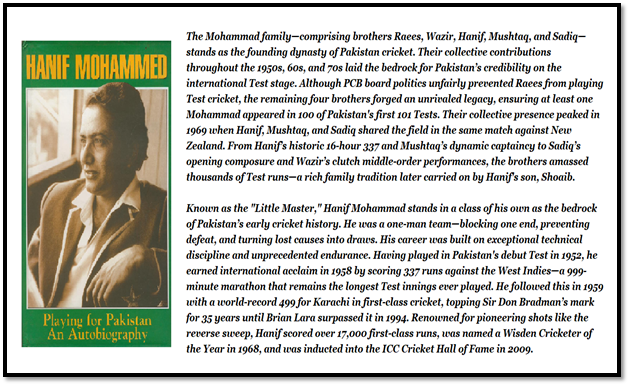
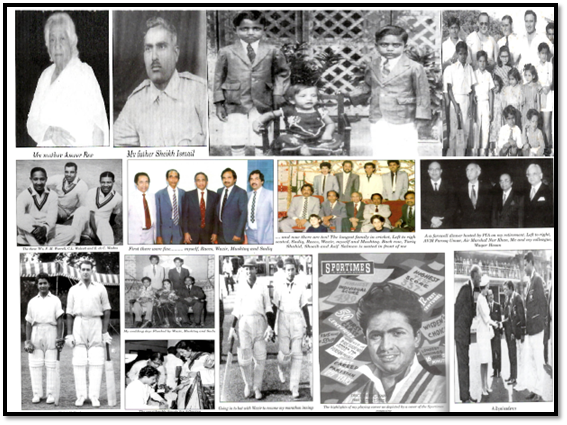
The Mohammed family—brothers Raees, Wazir, Hanif, Mushtaq, and Sadiq—stands as the founding dynasty of Pakistan cricket. Their collective contributions throughout the 1950s, '60s, and '70s laid the bedrock for Pakistan’s credibility on the international Test stage. Despite facing persistent unfair treatment from the Pakistan Cricket Board (PCB)—whose politics notoriously prevented Raees from playing Test cricket—the remaining four brothers forged an unrivaled legacy, ensuring at least one Mohammed appeared in 100 of Pakistan's first 101 Tests. Their collective presence peaked in 1969 when Hanif, Mushtaq, and Sadiq shared the field against New Zealand. From Hanif’s historic 16-hour 337 and Mushtaq’s dynamic captaincy to Sadiq’s opening composure and Wazir’s clutch middle-order performances, the brothers amassed thousands of Test runs—a rich family tradition later carried on by Hanif's son, Shoaib.
Known as the "Little Master," Hanif Mohammed stands in a class of his own as the bedrock of Pakistan’s early cricket history. He was a one-man team—blocking one end, preventing defeat, and turning lost causes into draws. His career was built on exceptional technical discipline and unprecedented endurance. Having played in Pakistan's debut Test in 1952, he earned international acclaim in 1958 by scoring 337 runs against the West Indies—a 999-minute marathon that remains the longest Test innings ever played. He followed this in 1959 with a world-record 499 for Karachi in first-class cricket, topping Sir Don Bradman’s mark for 35 years until Brian Lara surpassed it in 1994. Renowned for pioneering shots like the reverse sweep, Hanif scored over 17,000 first-class runs, was named Wisden Cricketer of the Year in 1968, and was inducted into the ICC Cricket Hall of Fame in 2009.
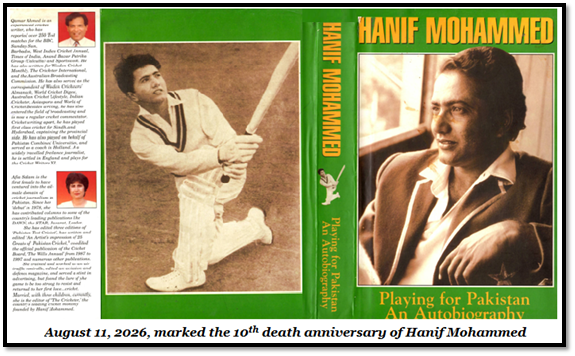
Hanif Mohammed: Playing for Pakistan - An Autobiography stands as a captivating, firsthand account from one of cricket's most legendary figures. As Pakistan’s original “Little Master,” Hanif’s reflections offer a rare window into the formative years of Pakistani cricket, charting the nation’s dramatic entry onto the international sports stage. Co-authored with cricket journalists Qamar Ahmed and Afia Salam, the book provides a rich blend of personal history, international camaraderie, and technical insight, making it a valuable historical artifact for enthusiasts of the game.
The author dedicated the book to his parents, Sheikh Ismael and Ameer Bee, whose constant encouragement supported his journey. The volume includes a table of contents, a preface by Hanif Mohammed, a foreword by Sir Gary Sobers, and thirty-five structured chapters. Key sections cover — Early Foundations : His upbringing, school cricket, migration after Partition, and Pakistan's 1952 Test debut. Historic Career Highlights : His record-breaking 337 against the West Indies, surpassing Don Bradman's first-class record with 499 runs, his first Test century, and tours across England, Australia, and the West Indies. Leadership & Later Years : Appointed Pakistan captain, knee surgery, political turmoil/retirement threats, and his life post-retirement as an administrator, writer, and coach. Family Dynasty & Reflections : Dedicated chapters exploring the Mohammed family legacy, statistical breakdowns, and his perspectives on the evolving nature of modern cricket.
In the preface, Hanif reflects on cricket as the central driving force of his life. He credits his mother as the primary family inspiration, his brother Wazir as a pillar of strength, and school coach Abdul Aziz for grooming his technique. Expressing gratitude for his administrative, coaching, and selection roles post-retirement, he notes how rule changes like covered pitches might have impacted his scoring today. He acknowledges key collaborators Qamar Ahmed and Afia Salam for helping compile his memoirs over eighteen months, alongside support from Hasib Ahsan and sponsor Shaukat Tarin.
West Indian legend Sir Garfield Sobers contributes the foreword, celebrating the Mohammed family as cricket's greatest dynasty—surpassing England's Graces and Australia's Chappells. Sobers vividly recalls facing Hanif during the 1958 Bridgetown Test, praising his legendary 16-hour, 337-run marathon against fierce pace bowling to save the match. Sobers highlights the family's incredible achievement of having at least one Mohammed brother represented in every Pakistan team for the country's first 25 years of Test history.
Hanif Mohammed was born on December 21, 1934, in Junagadh, India, into a sports-minded family where his mother, Ameer Bee, inspired him and his four brothers to pursue cricket. Following the 1947 Partition, his family fled to Karachi, Pakistan, enduring severe financial hardship after his father died in 1949. During his childhood, Hanif developed his foundational skills playing makeshift street cricket, received early bowling guidance from fast bowler Mubarak Ali, and was even dressed in girls' frocks by his mother, who had longed for a daughter.
Upon arriving in Karachi, former Indian cricketer Abdul Aziz Durrani ("Master Aziz") mentored Hanif, securing him a scholarship at Sindh Madrassah-tul-Islam and providing dedicated coaching. Under Master Aziz’s tutelage, Hanif quickly made a name for himself in school and domestic cricket. Highlights of his rapid rise included scoring an unbeaten 305 over seven and a half hours in the Rubie Shield, executing 12 dismissals as a wicketkeeper in a 1950 relief match, and making a flawless 158 against a top-tier attack featuring Fazal Mahmood. These early triumphs caught the attention of national leaders like Mian Muhammad Saeed and Abdul Hafeez Kardar, laying the groundwork for a legendary career defined by immense concentration and massive scores.
In the early 1950s, employment as a PWD road inspector provided Hanif with financial stability, enabling him to focus on cricket and mentor his brothers. Early Pakistani cricket thrived thanks to dedicated patrons like Makhdoomzada Hassan Mahmood, Pir Pagaro, Abdul Dyer, the Jaffar family, and the Parsi community. In November 1951, Hanif featured in Pakistan's historic victory over the touring MCC, scoring a resilient 64 runs that helped earn Pakistan official ICC Test status in July 1952. Ahead of Pakistan's inaugural Test tour to India later that year, Hanif trained under Alf Gover in England. During the tour, he scored Pakistan's first Test half-century in Delhi, earning the nickname "Little Master." Pakistan subsequently secured its first official Test victory in Lucknow, firmly establishing its presence on the international stage.
During the 1952 tour of India, Hanif Mohammed top-scored for Pakistan with 1,028 runs, compiling his maiden first-class double century and earning titles like "Mr Concentration" despite internal team friction. Returning home, he starred in Bahawalpur's 1953–54 Quaid-i-Azam Trophy victory. Ahead of the wet 1954 England tour, Pakistan underwent rigorous conditioning after Captain Abdul Hafeez Kardar survived an ouster attempt. Hanif silenced critics with a brisk 87 against Combined Services and a century against Somerset, while E.W. Swanton praised his resilience on damp wickets.
During Pakistan’s tour of the West Indies, Hanif produced a historic performance by batting 999 minutes to score 337, setting the record for the longest Test innings in history and securing a draw. Despite suffering sun glare damage and facing Roy Gilchrist's terrifying pace, Hanif finished the series with 628 runs, while Garfield Sobers set a world-record Test score of 365 not out. Upon returning home, Hanif's achievement was celebrated with unique gifts like a custom "UGO 337" license plate. Eleven months later, playing for Karachi in the Quaid-i-Azam Trophy, Hanif batted for over ten hours to score 499 runs—surpassing Don Bradman's first-class record before being run out due to a scoreboard error. Awarded the Pride of Performance medal, his 499 remained the highest first-class score for 35 years until Brian Lara surpassed it in 1994.
Between 1959 and 1962, Hanif navigated major international series alongside key personal milestones. In the 1959–60 home series against Australia, Pakistan lost 2–0, though Hanif scored an unbeaten 101 in Karachi while playing through a knee injury. Shortly after, he married his wife Shamshad, welcomed his youngest brother Sadiq into first-class cricket, and saw Pakistan adopt turf pitches per Richie Benaud's advice.
During the 1960–61 tour of India—which ended in five draws—Hanif scored 222 in a warm-up match and a heroic 160 in Bombay while battling injuries, becoming the first Pakistani to reach 2,000 Test runs. During this period, he joined PIA, met singer Lata Mangeshkar, and celebrated the birth of his son, Shoaib. Finally, during the 1961–62 MCC series, Hanif scored 111 and 104 not out in Dacca, becoming the first Pakistani to score a century in each innings of a Test.
Pakistan’s 1962 tour to England proved disastrous, resulting in a 4–0 Test series loss driven by poor team harmony under young captain Javed Burki and managerial embarrassment. Despite knee and finger injuries, Hanif scored 1,044 runs on the tour before undergoing a complex, successful knee surgery that saved his career. Appointed Pakistan captain for the 1964–65 season, Hanif led a young squad to a draw against Australia in Karachi—where Khalid Ibadullah scored 166 on debut—and subsequently neutralized Australia's bouncers on the tour Down Under. Between 1965 and 1968, Hanif represented the Rest of the World XI alongside global legends like Garfield Sobers and Rohan Kanhai. During the 1965 matches, amidst the India-Pakistan war, Hanif and Indian captain Mansur Ali Khan Pataudi showcased remarkable sportsmanship by jointly signing a goodwill telegram appealing for peace between their nations.
Following the 1967 tour of England, Hanif Mohammed was stripped of the national captaincy, sparking public outrage that culminated during the civil disturbance-marred 1969 MCC tour. During the Third Test in Karachi, an angry crowd rioting over Hanif's removal forced the first permanent abandonment of a Test match in history. The administrative hostility reached its peak during the 1969–70 New Zealand series when selection chairman Hafeez Kardar issued an ultimatum: retire or risk compromising the international careers of his brothers Mushtaq and Sadiq. Forced into a disheartened retirement at age 34 after 55 Tests, Hanif transitioned into impactful post-retirement roles. He managed sports administration at PIA, oversaw commercial developments like the Hockey Club of Pakistan's Astroturf pitch, and co-founded The Cricketer—Pakistan's first dedicated monthly cricket magazine—in 1972, leaving an enduring legacy on Pakistani sports journalism and administration.
Cricket underwent a major evolution with the advent of Kerry Packer’s World Series Cricket, corporate sponsorships, the rise of Sharjah, and technological advancements like neutral umpires and video reviews. Despite these global shifts, Pakistani cricket administration faced ongoing structural issues due to an un-elected board prone to political patronage and instability. Former administrators like Justice A.R. Cornelius, Air Marshal Nur Khan, and Arif Ali Khan Abbasi maintained historical stability by establishing professional systems, whereas recent management struggled with internal power struggles and match-fixing scandals. Central to Pakistan’s cricket identity is the unmatched legacy of the Mohammed family. Four brothers—Wazir, Hanif, Mushtaq, and Sadiq—represented Pakistan in 100 of its first 101 Tests, accumulating 10,938 runs and 29 centuries combined. With contributions from brother Raees and Hanif’s son Shoaib, the family left a multi-generational imprint on Pakistani cricket through playing, coaching, and administration.
The Mohammed family is a cornerstone of Pakistani cricket, producing ten first-class players, including four brothers—Wazir, Hanif, Mushtaq, and Sadiq—and Hanif's son Shoaib at the Test level. Mushtaq excelled as a match-winning all-rounder and shrewd captain, while Sadiq formed a legendary opening partnership with Majid Khan.
Hanif’s own career features historic milestones: scoring Pakistan's first Test century on home soil, a world-record 499 in first-class cricket, and the longest Test innings in history—a 999-minute 337 against the West Indies. Honored as a Wisden Cricketer of the Year in 1968, Hanif also held global icons in high esteem. He named Sir Garfield Sobers as the greatest player he ever encountered, alongside West Indian greats like the "Three Ws (Worrell, Weekes, Walcott)," Viv Richards, and Brian Lara, while also admiring English masters including Len Hutton, Jim Laker, and Ian Botham.
Among Indian stalwarts, he admires Vinoo Mankad, Sunil Gavaskar, Kapil Dev, and Sachin Tendulkar’s Bradman-like genius. For Australia, he praises Richie Benaud’s tactical captaincy, the Lindwall-Miller pace duo, Dennis Lillee, Jeff Thomson, and Shane Warne’s leg-spin. He further honors international greats including Barry Richards, the Pollock brothers, Sir Richard Hadlee, Sanath Jayasuriya, and Aravinda de Silva. Turning to Pakistan, Hanif credits pioneer Fazal Mahmood alongside run-machine Zaheer Abbas, Imran Khan’s elite leadership, Javed Miandad’s cricketing brain, and the reverse-swing mastery of Wasim Akram and Waqar Younis. Concluding on captaincy, he names Abdul Hafeez Kardar, Mushtaq Mohammed, Miandad, Imran, and Wasim as Pakistan’s finest leaders, alongside global captains Mike Brearley, Allan Border, and Arjuna Ranatunga.
The primary strength of the book lies in its intimate, highly detailed portraits of international cricket legends. Hanif dedicates substantial prose to evaluating his peers and successors across major cricketing nations, ranging from Indian masters like Vinoo Mankad and Sunil Gavaskar to Australian greats like Richie Benaud and Dennis Lillee. His analysis is both generous and technically astute; for instance, he offers deep praise for Sachin Tendulkar’s flawless technique while simultaneously dissecting the unorthodox, round-the-wicket line of Shane Warne.
Another major highlight is Hanif’s affectionate documentation of Pakistan’s early cricketing heritage. He chronicles the foundational contributions of iconic figures such as Fazal Mahmood—whom he credits with single-handedly placing Pakistan on the world cricket map—as well as opening partner Nazar Muhammed and strategic captain Abdul Hafeez Kardar. Furthermore, his narrative captures the deep familial legacy of the Mohammed family, illustrating how brotherhood, mentorship, and domestic competitions shaped generations of elite talent.
Hanif’s tactical commentary also adds immense depth to the text. Whether describing the psychological pressure of facing fast bowling or debating the exact tactical placement of fielders in crucial World Cup matches—such as his critical breakdown of Javed Miandad’s field positioning in 1996—his passion for the strategic nuances of the game shines through.
Despite its strengths, the book is not without notable limitations. The most prominent weakness is its structural reliance on itemized player profiles rather than a tightly woven, continuous narrative arc. At times, the autobiography feels more like a catalog of player evaluations and match memories than a deep, reflective personal memoir. Readers seeking a raw, emotionally vulnerable look into Hanif’s inner life, personal struggles, or off-field vulnerabilities may find the text overly focused on on-field statistics and sportsmanship.
Additionally, while Hanif touches upon board politics—such as the "players' revolt" against a young Javed Miandad or internal selection biases—his commentary on administrative controversies often remains diplomatic and restrained. The text occasionally avoids delving into the deeper institutional frictions within Pakistani cricket administration, choosing instead to focus on the positive aspects of sportsmanship and player camaraderie.
Hanif Mohammed: Playing for Pakistan - An Autobiography is a vital and affectionate chronicle of international cricket during a transformative era. Hanif approaches his -subjects not to settle old scores, but as a passionate student of the game, offering a masterclass in evaluating sportsmanship, technique, and leadership.
For cricket historians, the memoir is an indispensable primary source. It documents Pakistan's rise from its post-partition infancy—when players fought for legitimacy on matting pitches—to a World Cup-winning power led by figures like Imran Khan and Javed Miandad. Furthermore, Hanif's reflections build a bridge across generations, connecting classical legends like Len Hutton and Vinoo Mankad to modern stars like Sachin Tendulkar and Shane Warne.
Ultimately, the book stands as a monument to Pakistan’s original "Little Master". It is a humble, perceptive tribute that belongs on the shelf of anyone wanting to understand the history and tactical evolution of sub-continental cricket.
(Dr Ahmed S. Khan —dr.a.s.khan@ieee.org— is a Fulbright Specialist Scholar)