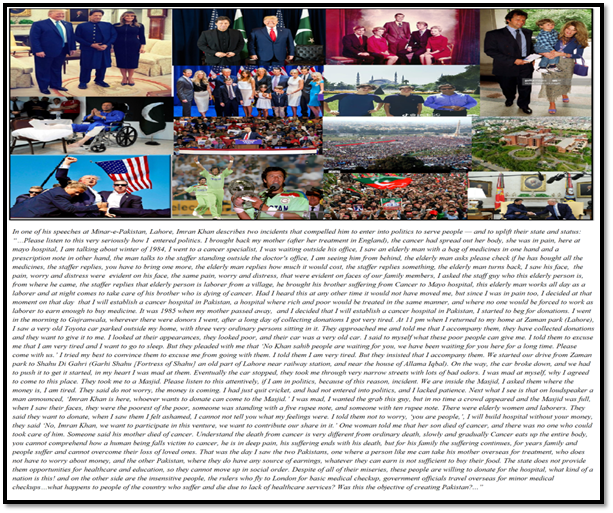
Book & Author
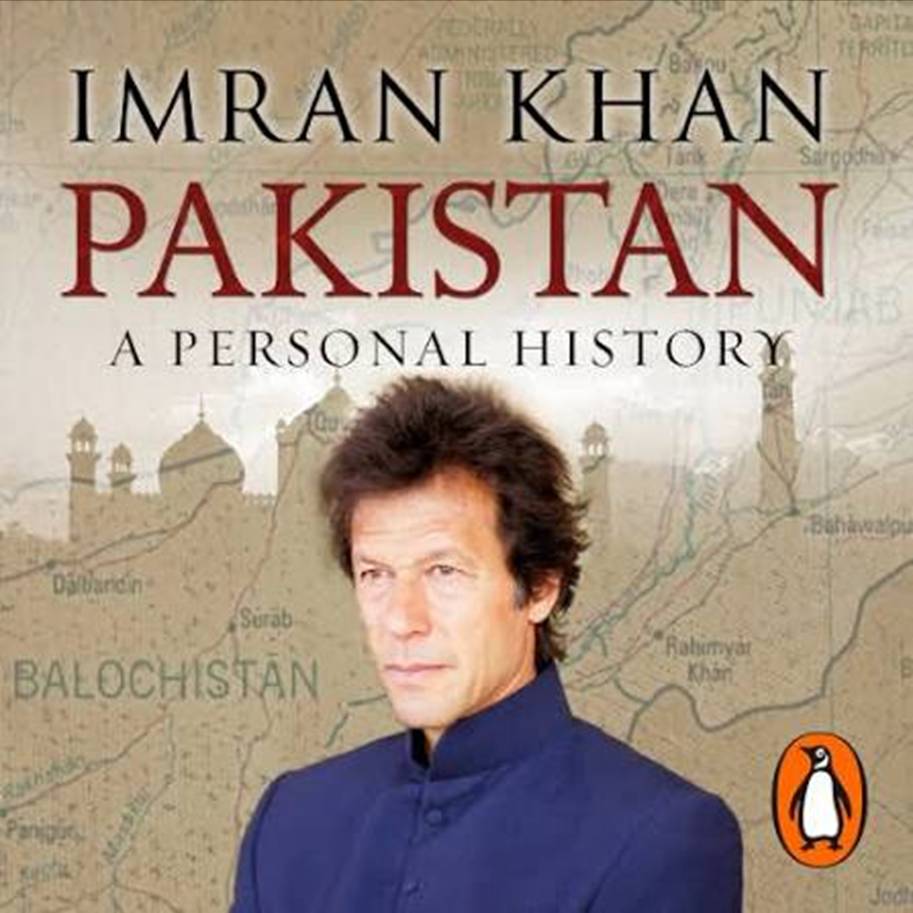
Imran Khan: Pakistan — A Personal History
By Dr Ahmed S. Khan
October 5, 2026, marks the 74 th birthday of Imran Khan
“I am convinced the moment the next elections are announced, a 'soft revolution' will explode on our political horizon and sweep away the corrupt status quo from Pakistan once and for all.”
"At the moment, we have a ruling class that has one law and the people another."
"Never give up, no matter how hard life gets, no matter how much pain you feel. Pain will eventually subside; nothing remains forever, so keep going and don't give up."
"Faith without wisdom and knowledge could produce bigots completely lacking in compassion and tolerance."
— Imran Khan
Global media outlets—including BBC News, Al Jazeera, Reuters, AFP, and The Guardian—have reported that former Prime Minister Imran Khan has suffered severe vision loss, retaining only 15% sight in his right eye. According to a court-appointed amicus curiae report submitted to Pakistan’s Supreme Court, the diagnosis was identified as central retinal vein occlusion (CRVO), a condition directly linked to delayed medical care in prison.
Khan, who was widely recognized as the popular-vote victor in the February 8, 2024, elections, has endured over 1,150 (more than 3 years) days of strict solitary confinement. Prior to his late-2025 deterioration, he maintained normal 6/6 vision in both eyes. However, after experiencing persistent haziness and repeatedly alerting Adiala Jail administrators, his complaints were ignored for nearly three months without a referral to an ophthalmologist. Instead, he was given basic eye drops, culminating in a sudden, severe drop in vision by early 2026.
Compounding these concerns, authorities have repeatedly denied Khan access to his family and personal doctors. Tensions escalated further following reports that authorities secretly transported him overnight to an unaccredited facility for an undisclosed procedure. This lack of transparency raises critical questions: Why were independent specialists excluded? Was informed consent obtained? And could the underlying vascular blockage extend beyond his eye to affect his heart or brain?
To safeguard his life and preserve national stability, Khan’s legal team and civil rights advocates demand his immediate release and transfer to an accredited hospital. There, under the care of his personal physicians, he can undergo comprehensive diagnostic imaging—including MRIs—with full informed consent.
While the Supreme Court of Pakistan has reiterated orders to transfer Khan to Shifa International Hospital for specialist evaluation, state compliance remains contested. Meanwhile, state crackdowns have extended to his family: his sisters, Aleema and Uzma Khan, were arrested during protests outside Adiala Jail and in Islamabad. Held in severe isolation and denied immediate legal access, their treatment has drawn widespread condemnation as political intimidation and a breach of fundamental human rights and Islamic values outlined in the Qur’an and Hadith.
On March 28, 2025, former Prime Minister Imran Khan was nominated for the Nobel Peace Prize for the second time by the Norwegian political party Partiet Sentrum. In their announcement on X, the party stated: “We are pleased to announce, on behalf of Partiet Sentrum and in alliance with an individual eligible to nominate, that Mr Imran Khan, the former Prime Minister of Pakistan, has been nominated for the Nobel Peace Prize for his contributions to human rights and democracy in Pakistan.” Having previously been nominated in 2019 for his regional peace efforts, this gesture underscores his decades-long struggle for democratic governance and rule of law.
Khan’s political career was driven by a vision to uplift Pakistan’s struggling masses, but his independent foreign policy—particularly his visit to Moscow on the day Russia invaded Ukraine to secure affordable energy for the poor—alienated both foreign powers and domestic military leadership. Khan maintains that he was removed from power over these policy disagreements with the establishment. Despite facing multiple health issues while enduring more than three years in harsh solitary confinement on what are widely viewed as fabricated charges, he remains the country's most popular figure.
History offers a stark warning: the lessons of the 1970 elections and the tragedy of December 16, 1971, must not be ignored. Myopic and ego-driven policies risk driving the country into severe economic breakdown and political instability. Should reason, law, and humanity prevail, Khan’s eventual release and return to office as Pakistan’s popular leader would mark a monumental shift, signaling an end to seven decades of de facto military rule that has stifled national growth. Preventing further harm—both to Khan’s health and to the nation—is essential for Pakistan's stability.
Over the past decade, Imran Khan and Donald Trump have emerged as two of the world's most prominent populist leaders. Their political careers share striking parallels: both have served as heads of state, built fierce anti-establishment identities, expressed unapologetic views, and maintained fiercely loyal followings. Furthermore, both face extensive legal challenges that they contend are politically motivated—a dynamic highlighting the complex friction between popular leaders and established institutions. Analysts warn that severe measures to suppress either figure risk sparking widespread civil unrest.
To address Pakistan’s systemic challenges, Imran Khan has outlined a 10-point roadmap for national development: 1. Tax Base Expansion: Broaden domestic revenue collection, 2. Export Growth: Boost exports to generate vital foreign exchange reserves, 3. Governance Reforms: Strengthen administrative efficiency and combat corruption, 4. Diaspora Engagement: Offer targeted incentives to attract foreign direct investment, 5. Industrialization: Expand local manufacturing to stimulate job creation, 6. Agricultural Modernization: Deploy modern techniques and financial support to increase farm yield, 7. Energy Sector Reforms: Restructure the power sector to eliminate shortages and lower production costs, 8. Human Capital Investment: Enhance public healthcare and education to build a skilled workforce, 9. Infrastructure Modernization: Upgrade transport and utility networks to enable commerce, and 10. Social Welfare Expansion: Strengthen safety nets for underprivileged communities.
In Pakistan: A Personal History , Imran Khan juxtaposes his personal and political journey against the backdrop of Pakistan’s turbulent history and major global events. A global icon in both cricket and philanthropy, Khan brings a unique perspective to Western readers as he narrates pivotal moments—from the end of the British Raj and the partition of India to the 1965 and 1971 wars, the 1979 Iranian Revolution, the Soviet invasion of Afghanistan, the post-9/11 war on terror, and the pervasive impact of domestic political corruption. Dedicated to his sons, Sulaiman and Kasim, as well as the youth of Pakistan, the memoir is framed by a prologue and epilogue spanning ten distinct chapters. These trace his early life, his spiritual evolution and philanthropic drive to build a world-class cancer hospital, his high-profile marriage, and his critique of Pakistan's governance—concluding with a call to rediscover the vision of Allama Iqbal as a blueprint for the nation's future.
He details how pivotal personal milestones—the tragic loss of his mother to cancer, the founding of Pakistan’s first specialized free cancer hospital, and a profound spiritual awakening—transformed his trajectory from global sports stardom to social reform, philanthropy, and political leadership. Through this personal lens, Khan presents a sweeping portrait of Pakistan’s political evolution, spanning from Partition in 1947 through the post-9/11 era. He delivers a blistering critique of the ruling feudal and political dynasties, accusing corrupt elites and recurring military interference of dismantling democratic institutions, entrenching dependence on foreign aid, and deepening systemic inequality. He further contends that Western geopolitical interventions have consistently undermined national sovereignty, alienated local communities, and fueled regional extremism.
At its core, the memoir outlines the founding vision of his political movement, the Pakistan Tehreek-e-Insaf (PTI): establishing a sovereign, rule-of-law-driven "Islamic welfare state" inspired by the egalitarian principles of early Medina. By fusing traditional values with aggressive anti-corruption reforms, Khan frames his movement as an enduring struggle to restore national dignity, dismantle elite privilege, and secure social justice for everyday Pakistanis.
The author in the prologue titled “A Coalition of the Crooked, November 2007,” referring to his encounter with a students’ group aligned with the Generals, observes: “Blank Faces. Faces With No Expressions. That's What I remember. About twenty of them had surrounded me and a few were pushing me. I asked them, 'What is it you want? Do you know what you are doing?' I could see some had pistols. Beyond the locked gates of the courtyard, people were shoving and shouting. More crowds of students peered down at me from the windows of the floors that ran round the quadrangle as they tried to see what was happening. I was furious. My political party, Tehreek-e-Insaf (Movement for Justice'), was allied to this group, as the students that had surrounded me were in the Islamic Jamiat-e-Tuleba (IJT), the students' wing of the Jamaat-e-Islami, Pakistan's oldest and most organized religious party. Both Jamaat-e-Islami and Tehreek-e-Insaf were part of the All Parties Democratic Movement campaigning for an end to General Pervez Musharraf's military dictatorship and the restoration of Pakistan's chief justice. Yet these students were working for a dictator who had issued orders to arrest me and behaving just like a gang of street thugs. Although I had heard tales about the IJT, I had not fully realized the kind of people they were. Everyone on the university campus is scared of them. Once known for their ideological views and great discipline, they appear to have degenerated into a kind of mafia or fascist group operating inside the university, bearing guns and beating people up. They stifle debate in an educational establishment that has in its time produced two Nobel laureates — the University of the Punjab was established in the late nineteenth century by the British, in the country's second city, Lahore. No government dares tackle them, ordinary students at the university are petrified of them and even the party they belong to, the Jamaat-e-Islami, does not seem to be able to control them. Much later I heard the Jamiat activists had been paid large sums of money to turn on me — allegedly by the government.”
In the prologue Imran Khan also describes the details of his harsh imprisonment by General Musharaf. But that was cakewalk compared to Generals’ current ‘Morsi-script’ treatment of him in the dungeons of Adiala jail!
In the Chapter titled “Rediscovering Iqbal: Pakistan’s future,” Imran Khan observes: “The decay and decline in Islamic intellectual thought, according to Iqbal, set in five hundred years ago when the door to ijtihad, a scholarly debate on our religion and its traditions, were closed. The Qur’anic principles — which for Muslims are eternal principles — needed constantly to be reinterpreted in light of new knowledge…Iqbal pointed out in his sixth lecture — of his outstanding Lectures on the Reconstruction of Religious Thought in Islam — that in the modern period things had changed ‘and the world of Islam is today confronted and affected by new forces set free by the extraordinary development of human thought in all its directions…The claim of the present generation of Muslim liberals to re-interpret the foundational legal principles, in light of their own experience and altered conditions of modern life, in my opinion, is perfectly justified. The teaching of the Qur’an that life is a process of progressive creation necessitates that each generation, guided but unhampered by the work of its predecessors, should be permitted to solve its own problems.’”
In the epilogue, discussing the problems faced by Pakistan, Imran Khan states: “Pakistan has one of the lowest tax collection rates in the world with a tax-to-GDP ratio of about 9 per cent — only about 2.5 million are registered to pay tax, representing less than 2 percent of the population. The country relies instead on sales tax, which of course everybody pays at the same rate, regardless of income. The poor effectively subsidize the rich, and the powerful do everything they can to maintain this injustice. Our politicians are some of the worst culprits. A survey found 61 per cent of Pakistani parliamentarians pay no tax at all. According to his 2009/2010 tax returns, the billionaire Nawaz Sharif paid income tax of 5,000 rupees (about US$60), while Zardari paid nothing at all. Rich landowners also participate in this ruthless exploitation of the poor; agriculture is untaxed, despite the industry employing almost half the population. Five per cent of the farmers own 37 per cent of the land, yet they pay no income tax. So, the United States, by giving the Pakistani government aid in return for its contribution to the 'war on terror', is simply propping up this appalling system. Why should the Pakistani rich bother to pay taxes when foreign loans and aid money are always there to cover up their incompetence and corruption and pay for their lavish lifestyle? And why should politicians bother to fix the economy when they can artificially maintain it with American dollars?”
Continuing his narration of the problems faced by Pakistan, Imran Khan notes: “Every day the newspapers are filled with reports of people killing themselves and sometimes their families because of desperation over how to make ends meet. Thirty-four thousand innocent people have been killed since 2003; millions have been displaced by fighting and we are facing civil war in the tribal areas and a rising insurgency in Baluchistan. The country today faces unprecedented unemployment, inflation, breakdowns in infrastructure, shortages of gas and power, and lawlessness. The war has been a disaster for the people but made the powerful richer. Our capital is like a city under siege, its people subject to routine security checks as if every Pakistani is a potential terrorist, a situation the police often make use of to extract bribes. Capital is pouring out of the country. A fortune is spent on the security of politicians, to the detriment of the rest of the population. In Punjab, almost half of a 900-strong elite police force is deployed to protect the Sharif family, while 64 per cent of all police in the capital are on VIP duty.”
Expounding on the foreign policy, Imran Khan observes: “Our foreign policy has to be sovereign and needs to be reviewed with all our neighbors — especially India. All our disputes with India should be settled through political dialogue…The US should be made to understand that it is in their interests to back a sovereign democratic government in Pakistan.”
Envisioning the future, Imran Khan states: “The way forward has to be for this puppet government to resign, as it has failed on every front. Then, under the auspices of the Supreme Court, free and fair elections should be held. Only free and fair elections will bring in a credible sovereign government that represents the aspirations of the people of Pakistan…I am convinced the moment the next elections are announced, a 'soft revolution' will explode on our political horizon and sweep away the corrupt status quo from Pakistan once and for all.”
Pakistan — A Personal History , is an interesting book that provides personal history and political and economic philosophies of a great leader — Imran Khan. The book is essential reading for all.
(Dr Ahmed S. Khan — dr.a.s.khan@ieee.org — is a Fulbright Specialist Scholar)