|
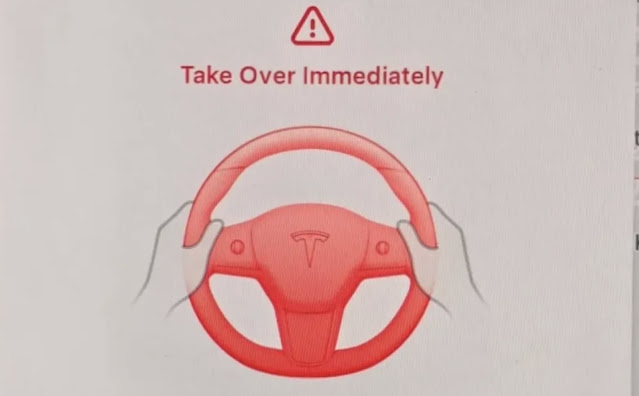
Tesla FSD Warning |
AI on Wheels: My Experience with Tesla Full Self Drive (FSD)
By Riaz Haq
CA
Recently, I saw a news story suggesting that “more and more seniors are using Tesla FSD (full self drive)”. This prompted me to share my own experience with my readers.
My wife and I have been regularly using Tesla Full Self Drive (Supervised FSD) software for several months now. It is a subscription costing $108.16 per month, including tax, per vehicle. Our experience has generally been positive.
We set our destination in the navigation system and let FSD drive us. It pulls out of our driveway, takes us wherever we want to go, and parks on the street, in a parking lot, or in a garage. On occasion, though, we have had to take control when we felt it was necessary, often in response to Tesla warning to “take over immediately”.
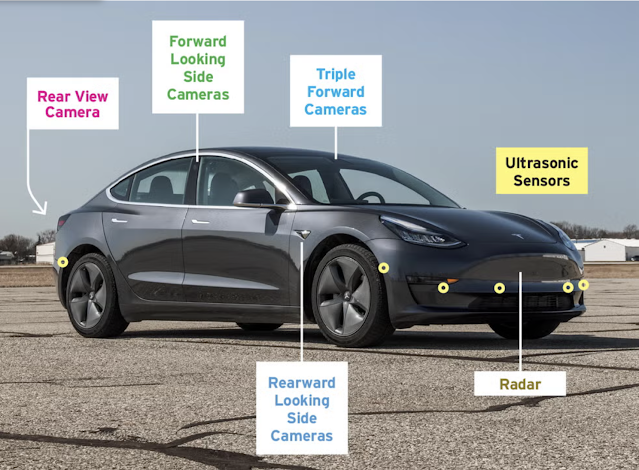
Tesla sensors - Source Car and Driver Magazine |
Both of our Tesla Model Y vehicles use hardware version 3 (HW3). In addition to a computer, HW3 includes 7 cameras and four ultrasonic sensors. We get frequent Tesla software updates, downloaded over the air.
As of today, we're on software version 2026.21.6, including FSD v14.3.7. The latest hardware version on new Tesla vehicles is HW4. Tesla recently outlined details on Full Self-Driving (FSD) v15, describing it as a major "step-change" in capability featuring a 10-billion parameter neural network. Tesla confirmed that current Hardware 4 (AI4) computers will natively support v15 and unsupervised features, targeting a late 2026 to early 2027 rollout window.
|
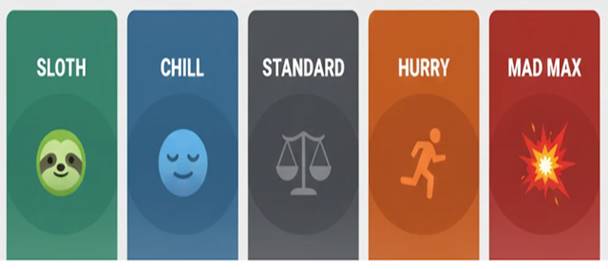
Tesla FSD Speed Modes - Source Jowua |
Tesla FSD allows you to choose a driving mode. The choices include Sloth (least aggressive), Chill, Standard, Hurry and Mad Max (most aggressive). Here are more detail on each speed mode:
Sloth: The most cautious setting. It stays strictly at or slightly below the speed limit, favors slow right lanes on highways, and avoids proactive passing.
Chill: A relaxed, smooth profile. It generally targets the exact speed limit and makes fewer or less urgent lane changes.
Standard: The balanced, default setup. It typically drives roughly 5 to 7 mph over the speed limit (traffic permitting) and maintains an average commuting pace.
Hurry: A faster profile designed for quicker travel times. It allows higher offsets above the speed limit and executes more assertive lane changes to pass slower vehicles.
Mad Max: The most assertive profile, built for heavy gridlock or aggressive urban environments (like dense city traffic). It proactively navigates gaps, moves swiftly around traffic flow, and executes maneuvers with higher urgency.
We drive mostly in Standard or Hurry modes. The best part my wife likes is how smoothly it changes lanes even in high traffic conditions. One particular place where it has eliminated her stress is on Oakland Maze, where her route requires 5 quick lane changes to go from one freeway to another.
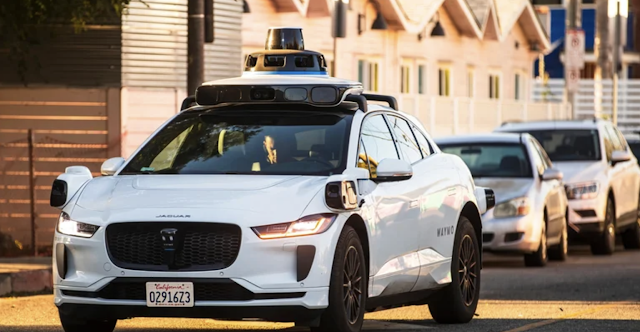
Waymo Robotaxi with LiDAR mounted on top |
There have been several instances where we have had to intervene to take control of the vehicle. These include loss of control when the front camera is blinded by direct sun at certain times of the day. This problem would probably not occur if Tesla vehicles were equipped with a LiDAR scanner that uses laser light pulses to measure distances and create accurate, 3D digital models of objects and environments. Robotaxis like Google's Waymo and Amazon's Zoox use LiDAR devices to achieve fully autonomous driving. However, like the rest of Tesla's vehicle lineup and Full Self-Driving stack, the recently announced Cybercab robotaxi also relies entirely on a vision-based camera system and onboard AI to interpret its surroundings.
In other instances, our Tesla car ran a stop sign that was blocked by a parked truck. It failed to read "STOP" painted on the road surface. At a local Safeway supermarket, it attempted to park in a shopping cart corral. A couple of times after pulling out of our driveway, it took a wrong turn but found its way back to the correct route after taking a detour.
Rapid development and deployment of AI applications like Tesla full self drive and various robotaxi services, including Waymo and Zoox, have broad social and economic implications. It is likely to make transportation safer, but it also threatens the livelihoods of tens of millions of taxi and truck drivers around the world. There have already been protests by drivers' unions in many major cities like London and New York.
(Riaz Haq is a Silicon Valley-based Pakistani American analyst and writer. He blogs at www.riazhaq.com)