Book & Author
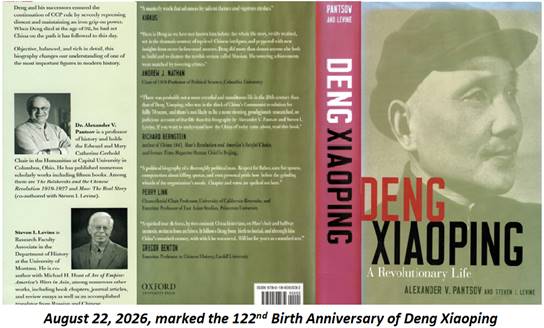
A. Pantsov & S. Levine: Deng Xiaoping — A Revolutionary Life
By Dr Ahmed S. Khan
"It doesn't matter whether the cat is black or white, so long as it catches mice."
“Cross the river by feeling for stones.”
“One country, two systems.”
Standing only five feet tall, Deng Xiaoping was one of the 20th century's greatest revolutionaries. Over less than four decades, his economic policies transformed China from a developing nation into the world's second-largest economy. As the éminence grise of China, he navigated a volatile career—enduring three periods of disgrace and three rehabilitations—and ultimately created modern China by stepping away from Maoism in favor of market-driven reforms.
Deng’s historical legacy remains complex and deeply conflicted. Officially praised in China as a master strategist and the chief architect of socialist modernization, he was also a ruthless dictator accountable for mass human loss during mid-century campaigns and the 1989 Tiananmen Square massacre. Deng personally evaluated his life as a "fifty-fifty" balance of merits and demerits, acknowledging that any accurate history must account for both his major achievements and his grave errors.
In Deng Xiaoping: A Revolutionary Life, historians Alexander V. Pantsov and Steven I. Levine deliver an unsparing biography that dismantles many of the myths surrounding China’s paramount leader. Drawing heavily on previously classified Soviet archives, Pantsov and Levine present a definitive portrait of a figure who was neither a closet capitalist nor a Western-style reformer, but rather an unyielding Bolshevik-Maoist loyalist whose pragmatism was always subordinate to party supremacy.
Alexander V. Pantsov is a Russian-born historian, author, and scholar specializing in Chinese and Soviet political history. He graduated from the Institute of Asian and African Studies at Moscow State University in 1978 and later served as Professor of History and held the Edward and Mary Catherine Gerhold Chair in the Humanities at Capital University in Columbus, Ohio.
Pantsov is widely acclaimed for his biographical works on key 20th-century Asian leaders, frequently collaborating with translator Steven I. Levine. His major publications include Mao: The Real Story (2012), Deng Xiaoping: A Revolutionary Life (2015), and Victorious in Defeat: The Life and Times of Chiang Kai-shek (2023). Pantsov’s scholarship is distinctive for leveraging deep expertise in the Chinese language alongside native Russian fluency, allowing him to utilize previously secret Soviet and Comintern archives to reshape understanding of modern Chinese history and Sino-Soviet relations
Steven I. Levine is a retired professor and prominent historian specializing in modern Chinese politics, foreign policy, and American-East Asian relations. He holds a PhD in political science from Harvard University. Over his extensive academic career, Levine has taught at institutions including Columbia University, American University, Duke University, and the University of Montana, where he served as the Mansfield Professor of Asia Pacific Studies.
Levine is widely recognized for his highly acclaimed collaborations with Russian historian Alexander V. Pantsov. Utilizing his deep expertise in Chinese language and history, Levine has served as co-author and translator for several definitive biographies, including Mao: The Real Story, Deng Xiaoping: A Revolutionary Life, and Victorious in Defeat: The Life and Times of Chiang Kai-shek.
The book outlines the three major phases of his life and political career, chronologically organizing his journey across three primary thematic eras: "The Bolshevik," "The Maoist," and "The Pragmatist".
The early chapters trace Deng's ideological origins from his birth and early European exposure to Moscow, detailing his role in key revolutionary actions from Xi'an to Guangxi. The mid-section follows his rise through the Chinese Communist Party during the Maoist era, highlighting his leadership in the Taihang Mountains, his executive governance in the Southwest Region, and his eventual ascension to high-level Beijing politics. This section also covers his political setbacks, including his struggle with Maoist ideology, his critique of the cult of personality, and his fall from power when designated as the "Number Two Capitalist Roader" during the Cultural Revolution, leading to his arrest and exile.
The final section focuses on Deng's post-exile resurgence as China's primary reformer. Chapters detail his establishing of "practice as the criterion of truth," his economic philosophy that allowed individuals to "get rich first," and the strategic concept of "One Country, Two Systems". It concludes by addressing the political tensions of his later leadership, including the Tiananmen Square crisis, before reflecting on his final years as a retired patriarch. The book is rounded out by detailed appendices detailing Deng’s chronology and genealogy, alongside extensive archival notes and references.
In the introduction, the authors set the biographical and analytical scope of the book, contrasting Deng Xiaoping’s reputation as an economic miracle-worker with his tragic decision to crush the 1989 Tiananmen Square democracy movement. The authors frame Deng’s complex legacy around a central contradiction: how a visionary reformer who embraced market socialism and lifted millions out of poverty could simultaneously order the military suppression of his nation's youth to maintain the absolute, totalitarian rule of the Chinese Communist Party. The authors argue that while Deng broke away from Mao Zedong’s utopian economic policies, he remained deeply committed to party dictatorship, viewing political dissent not as a move toward healthy governance, but as a dangerous path toward total chaos.
To decipher Deng's long life and career, the authors draw on newly available, previously unexamined archival material, most notably extensive personal dossiers from Russian state archives and interviews with key historical figures. This broad perspective allows the book to offer a rigorous, objective reassessment that challenges popular misconceptions. Contrary to the narrative that Deng was a lifelong moderate opposed to Maoist extremism, the text reveals him as a loyal disciple who actively supported Mao’s radical policies for decades—including land reform, Stalinization, and the Great Leap Forward—before finally breaking with economic Maoism after the Chairman's death. Furthermore, the introduction section clarifies that Deng was not the original inventor of China's market reforms; rather, he adapted Vladimir Lenin’s New Economic Policy principles—which he had learned in 1920s Moscow—and took cues from spontaneous peasant initiatives to dismantle collective farming.
Ultimately, the authors declare Deng as a pragmatic, politically ruthless bureaucrat who viewed human lives primarily as instruments to achieve state goals. While acknowledging his monumental achievements in modernizing China and integrating it into the global economy, the authors insist on viewing him without political bias or hero-worship. Deng is depicted not as a liberal democratic reformer, but as a rigid guardian of party power whose complex worldview ultimately produced both China's economic rise and the tragedy of Tiananmen Square.
One of the book’s most valuable contributions is its detailed exploration of Deng’s early formational years in Paris and Moscow during the 1920s. Utilizing previously inaccessible archives from the Communist International (Comintern), the authors reveal how Deng was shaped by the Soviet environment.
The authors introduce a compelling argument regarding the origins of "Reform and Opening Up" (Gaige Kaifang): Deng’s embrace of market mechanisms in the late 1970s was not a rejection of Communism, but an application of Nikolai Bukharin’s interpretation of Lenin’s New Economic Policy (NEP). Having studied the NEP during his student days at Sun Yat-sen University in Moscow, Deng understood that allowing limited private enterprise under state control was a recognized Bolshevik strategy to rebuild a shattered economy without sacrificing political control.
While popular history often frames Deng as Mao Zedong’s ideological rival, the authors demonstrate that Deng was one of Mao’s most fiercely loyal lieutenants for decades. The authors meticulously document Deng’s role in executing some of the regime's harshest measures: 1. Southwest Governance: Deng’s brutal implementation of land reform in Southwest China, executing thousands of alleged counter-revolutionaries with such fervor that even Mao suggested moderating the pace; 2. The Anti-Rightist Campaign (1957): As General Secretary, Deng enthusiastically directed the purge of over 500,000 intellectuals and dissidents, destroying China’s educated class for a generation; and 3. Complicity in the Great Leap Forward: Though Deng later distanced himself from the disastrous economic policies that caused millions of deaths, the authors show he was largely complicit in enforcing grain requisitions and suppressing dissent during the initial stages of the famine.
Deng’s periodic purges—most notably during the Cultural Revolution—were not because he opposed Mao’s ultimate goal of a totalitarian Communist state, but because Mao became paranoid about party administration. Deng’s famous survival skill was his ability to make humiliating self-criticisms, biding his time until the storm passed.
When Deng finally consolidated power in the late 1970s after outmaneuvering Hua Guofeng, he prioritized modernization. However, the biography sharply disputes the notion that Deng personally masterminded every economic innovation. The authors emphasize that many reforms were bottom-up movements initiated by desperate rural peasants or conceived by economic planners like Chen Yun. Deng’s true genius was his political permission structure—he had the authority to protect these experiments from hardline ideological attacks.
Deng’s commitment to economic openness was strictly bounded by his Four Cardinal Principles: 1. Upholding the socialist road, 2. Upholding the people's democratic dictatorship, 3. Upholding the leadership of the Communist Party, and 4. Upholding Marxism-Leninism and Mao Zedong Thought.
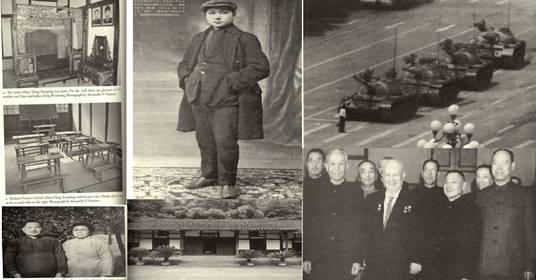
When political demands threatened Party hegemony during the 1989 Tiananmen Square protests, Deng did not hesitate. Viewing the student demonstrators as counterrevolutionaries bent on destabilizing the state, Deng ordered the military crackdowns. Pantsov and Levine illustrate how Tiananmen was not an anomaly, but the logical culmination of Deng’s lifelong belief in Lenin’s concept of absolute party discipline.
In the epilogue, the authors note that Deng Xiaoping passed away on February 19, 1997, leaving strict instructions regarding his postmortem treatment. Rejecting any elaborate arrangements, he requested that no funeral meeting be held and that his eyes be donated to medical science. Following a simple clinic farewell, his remains were transported to the crematorium as tens of thousands lined the streets, and a formal memorial gathering was later held in Beijing where Jiang Zemin delivered a eulogy. In accordance with Deng's final wishes, his ashes were scattered over the ocean by his widow and high-ranking officials.
Today, the rapid modernization across major urban hubs like Beijing, Shanghai, Chongqing, and Xi'an stands as a testament to the economic transformation Deng set in motion. Shanghai’s Pudong district and vibrant commercial arteries reflect a flourishing market culture filled with global brands and consumer goods. Despite this economic success, political freedom remains strictly controlled. Annual Hong Kong vigil demonstrations honoring the victims of the June 4, 1989, Tiananmen Square crackdown highlight a historical legacy that is largely suppressed on mainland China. Deng established an authoritarian system anchored by the Communist Party’s unchallengeable rule and guided by his Four Cardinal Principles.
This dynamic created a unique model of authoritarian socialism grounded in a market economy. While critics often compare Deng to Mikhail Gorbachev, key structural differences rendered China's trajectory distinct. Unlike the Soviet Union, China benefited from: Agrarian reforms driven spontaneously by rural peasants; massive capital investments provided by the overseas Chinese Diaspora (huaqiao); exceptionally low labor costs that fueled rapid manufacturing growth; a party cadre system less corrupted by institutional stagnation, and minimal defense budget constraints relative to USSR Cold War spending, enabling targeted economic investments.
The major strengths of the book are: 1. Archival Depth: The inclusion of Russian archives fills massive biographical gaps regarding the CCP's international connections and Deng's personal life, 2. Unbiased Tone: Avoids the hagiography found in official party histories as well as overly simplistic Western caricatures, and 3. Political Nuance: Successfully connects Deng’s 1980s economic strategies back to early 20th-century Bolshevik economics.
The key weaknesses of the book are: 1. Psychological Speculation: At times, the narrative attributes specific internal motivations to Deng during key decisions without direct documentary proof, and 2. Uneven Focus: The book dedicates substantial space to pre-1949 family dynamics and early maneuvers, occasionally rushing through complex foreign policy maneuvers in the late 1980s.
Deng Xiaoping: A Revolutionary Life is a vital, revisionist biography that strips away decades of geopolitical romance. The authors, Pantsov and Levine, paint a chilling yet realistic portrait of a man who saved the Chinese Communist Party by modernizing its economy, ensuring its survival long after the Soviet Union collapsed. It is essential reading for anyone seeking to understand not only the history of 20th-century China, but the authoritarian foundations of China’s modern global stance.
(Dr Ahmed S. Khan — dr.a.s.khan@ieee.org— is Fulbright Specialist Scholar.)