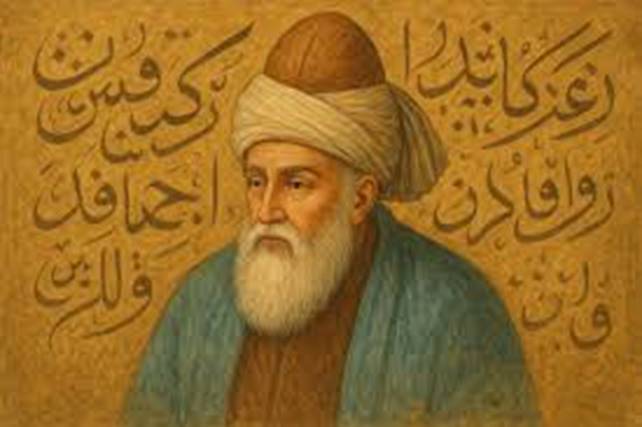
Pakistan Link will publish 19 short biographical essays on some of the greatest spiritual luminaries in Islamic history, from Rābiʿa al-ʿAdawiyya to Jalāl al-Dīn Rūmī and Khwāja Muʿīn al-Dīn Chishtī. Together, these essays would form a coherent spiritual journey—from renunciation and detachment, to ecstatic divine love, and ultimately to the human calling to know, love, and serve God. These essays are condensed from a chapter in Professor Nazeer Ahmed’s recently completed book, Faith, Love and Reason in Islamic History.
Tasawwuf has been one of the great sustaining forces in Islamic history. In times of upheaval and decline, it preserved not only faith, but the inner life of faith, the longing, remembrance, and resilience that kept the lamp of Islam burning. Yet this luminous inheritance is increasingly lost to today’s youth amid modernity, secularism, materialism, war, and the relentless distractions of the digital age. It is our hope that this series will help rekindle that lost flame and inspire a new generation to rediscover the spiritual depths of their tradition. According to the eminent author of ‘Faith, Love and Reason in Islamic History’, Professor Nazeer Ahmed, “no lasting renewal of Muslim civilization can come without spiritual renewal. A civilization must awaken from within before it can rise again.”
Reclaiming our Spiritual Heritage… Rābiʿa al-ʿAdawiyya
By Prof Nazeer Ahmed
Concord, CA

Among the earliest and most beloved figures in the history of Islamic spirituality, few possess the symbolic and enduring power of Rābiʿa al-ʿAdawiyya of Basra (d. ca. 801 CE). Revered across the centuries as one of the great saints of Islam, Rābiʿa occupies a unique place in the genealogy of taṣawwuf. If Ḥasan al-Baṣrī helped establish the early Sufi grammar of repentance, renunciation, fear of divine judgment, and vigilance over the soul, Rābiʿa gave that grammar a new center of gravity: love. In her life and remembered teachings, the inner life of Islam was not merely disciplined by fear or purified by moral struggle; it was drawn upward by a consuming and unconditional love of God.
For this reason, Rābiʿa is often regarded not only as one of the earliest women saints in Islam, but as one of the most transformative spiritual figures of the formative Sufi age. Her importance lies not in the authorship of formal theological works, nor in the establishment of an institutional school, but in the profound spiritual sensibility she bequeathed to the Muslim imagination. She represents a decisive turning point in the development of Islamic spirituality: the moment at which zuhd (the renunciation of worldly attachment) was reoriented from mere austerity into a luminous longing for God.
Historically, Rābiʿa belongs to the early ascetic milieu of Basra, one of the great cities of early Islamic piety, preaching, and moral seriousness. Basra had already produced figures such as Ḥasan al-Baṣrī, whose warnings against heedlessness, attachment to the world, and forgetfulness of the Hereafter shaped the earliest ethos of renunciant devotion. It was a city marked by intense religious reflection, political unrest, and spiritual searching. In this atmosphere, Rābiʿa emerged as a figure at once continuous with this early Basran asceticism and radically transformative of it.
Traditional accounts of her life, preserved in later Sufi literature, often emphasize poverty, servitude, solitude, prayer, and absolute trust in God. As with many early saints, the historical details are interwoven with hagiographic memory, and modern scholarship rightly distinguishes between what can be securely established and what belongs to the language of devotional remembrance. Yet even when approached critically, the broad outlines remain clear: Rābiʿa was remembered as a woman of extraordinary piety whose life of worship, renunciation, and spiritual intensity made her one of the most compelling exemplars of early Islam’s inner path.
What distinguishes Rābiʿa most profoundly is the quality of her devotion. Earlier ascetic piety often emphasized fear of divine judgment, sorrow for sin, and detachment from worldly life. These themes remain present in her spirituality, but they are transformed. In Rābiʿa’s vision, the highest worship is not motivated by fear of Hell or desire for Paradise, but by love of God for God’s own sake. Her most famous prayer, preserved in many versions, captures the essence of her legacy: that if she worships God out of fear of Hell, may she be denied it; if she worships Him in hope of Paradise, may she be excluded from it; but if she worships Him for His own sake, may she not be deprived of His eternal beauty.
Whether or not every formulation can be traced with strict historical certainty, the spiritual truth they express became central to Sufi consciousness. Rābiʿa’s enduring contribution was to articulate, in unforgettable form, a principle that would echo through centuries of Sufi teaching: that the soul’s highest station is pure love (maḥabba), a love freed from calculation, self-interest, and even spiritual ambition. In her, worship becomes not transaction but surrender; not merely obedience, but intimacy; not simply renunciation of the world, but attraction to the Divine.
This shift was of immense significance for the history of taṣawwuf. Rābiʿa did not reject the disciplines of repentance, self-examination, or ascetic struggle that marked the earlier tradition. Rather, she transfigured them. She showed that renunciation is not simply saying “no” to the world but saying “yes” to God with such fullness that the world loses its hold. Zuhd, in her example, becomes not grim withdrawal but the clearing of the heart for divine presence. In this sense, she helped prepare the way for later Sufism’s richer language of longing, intimacy, yearning, and spiritual union.
Rābiʿa’s importance is also profound in relation to women’s spiritual authority in Islam. She lived in a world in which public religious authority was overwhelmingly male, yet she came to be remembered not as an exception to be politely admired, but as a spiritual archetype. Later Sufi literature places learned men, preachers, and ascetics in conversation with her, often portraying them as humbled by the clarity and intensity of her insight. Whatever literary embellishments later narratives contain, their cumulative significance is unmistakable: the Sufi tradition remembered Rābiʿa as proof that sanctity is not determined by gender, social status, or institutional office, but by the purity of the heart and the sincerity of devotion.
This is one of the most universal and enduring dimensions of her legacy. Rābiʿa established, in the deepest spiritual sense, that the path to God is open to all who are willing to discipline the soul, purify intention, and give themselves wholly to divine love. Her authority was not political, juridical, or institutional. It was existential and spiritual. She became a model not because she held office, but because she embodied truth.
In relation to theology and reason, Rābiʿa speaks from a pre-systematic register. She did not participate in formal kalām or philosophical speculation, nor did she seek to build a conceptual system. Yet her spirituality carried profound theological implications. By placing love above fear, reward, and religious self-interest, she challenged any understanding of faith that reduces religion to external conformity or legal calculation. She did not deny law, nor did she dismiss reason; rather, she subordinated both to a higher interior sincerity. In her vision, reason has its place, but the deepest apprehension of God comes through a heart made transparent by devotion. Love itself becomes a kind of knowledge—an affective and intuitive mode of gnosis.
For contemporary Muslims, Rābiʿa al-ʿAdawiyya remains astonishingly relevant. In an age often dominated by performance, anxiety, and outward display—even in religious life—she recalls us to the forgotten center: why do we worship? Is devotion motivated by habit, fear, social expectation, or self-interest? Or is it animated by a sincere longing for God? Her example does not abolish fear, hope, or duty; rather, it orders them beneath love, which alone perfects worship.
Rābiʿa al-ʿAdawiyya thus endures as one of the great saints of Islam and one of the clearest voices in the early history of taṣawwuf. She transformed the spiritual mood of Islamic devotion by showing that the highest form of worship is neither fear-driven nor reward-seeking but rooted in pure love of the Divine. She remains the archetype of female sanctity in Sufism, the saint of Basra whose heart burned so brightly with love of God that her memory still illuminates the path for seekers today.